
Made to measure stair carpet runners, supplied and fitted across North London by our own fitting team. Flatweave, wool, herringbone and striped runners, finished with a bound tape border, whipped edge or leather trim. Which? Trusted Trader, 20 years of fitting, over 300 reviews, and a showroom in North Finchley.
Featured project
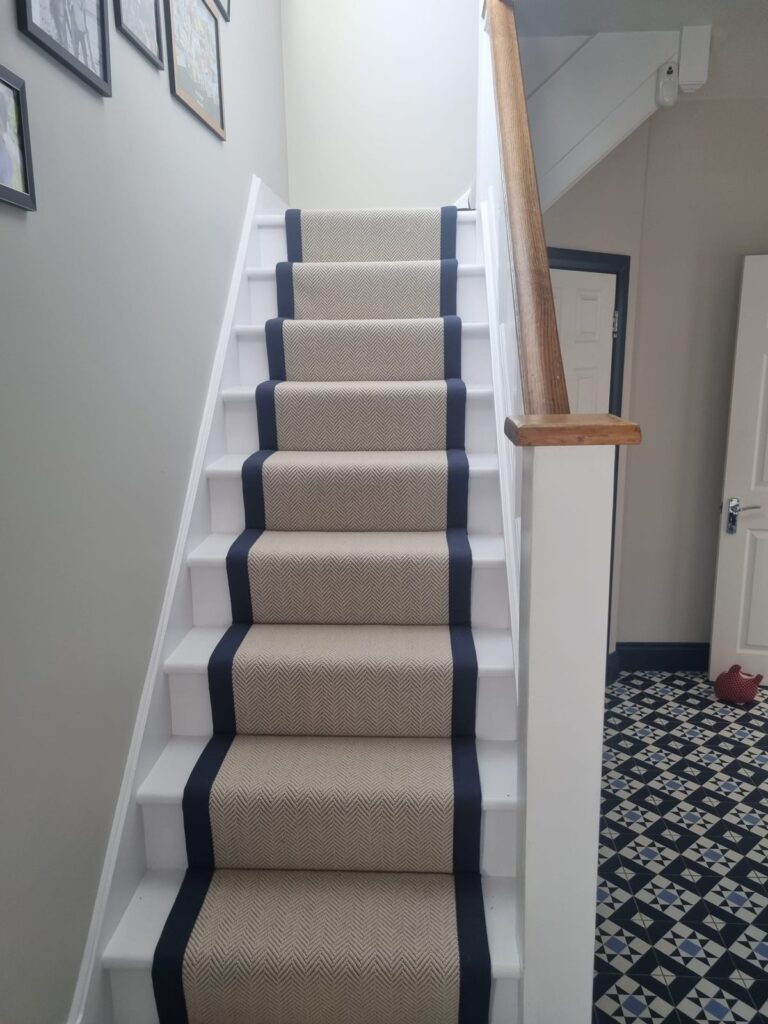
This Victorian terrace in Barnet came to us with the staircase stripped back and painted, the old carpet lifted and the treads waiting. The client wanted the paintwork left visible either side, with a textured natural runner up the centre and a strong border to tie in with the encaustic hallway tiles.
Location: Barnet, North London
Runner: Fibre Flooring Flatweave Classics Herringbone, colour Lunar
Border: Basketweave Ocean tape, bound both edges
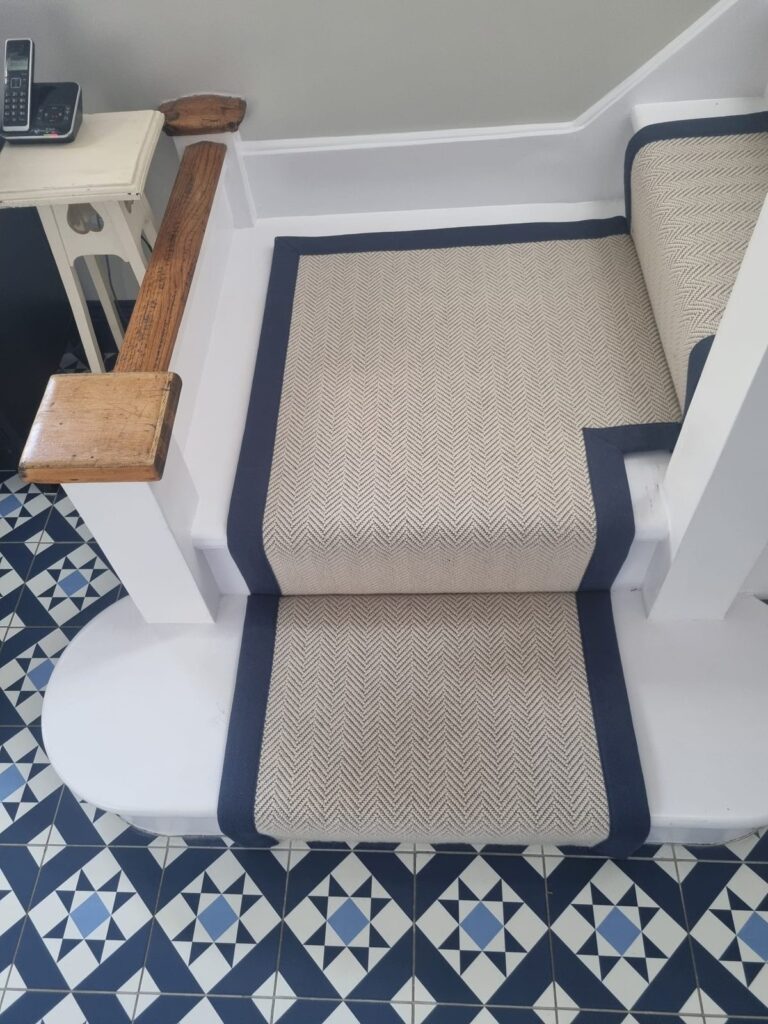
Staircase: Straight flight with a winder landing and bullnose bottom step
Fitting: Gripper rods with underlay, runner fitted to the tread and riser
More completed work is on our projects page, and you can read what clients have said on our testimonials page. We cover this part of North London in detail from our Barnet service area.
A stair runner does something a fully fitted stair carpet cannot. It leaves the timber or painted edges of the staircase on show, draws the eye up the flight, and gives you a hardwearing centre strip exactly where the wear happens. On a period property in Barnet, Highgate or Muswell Hill, that combination of practicality and character is usually what people are after.
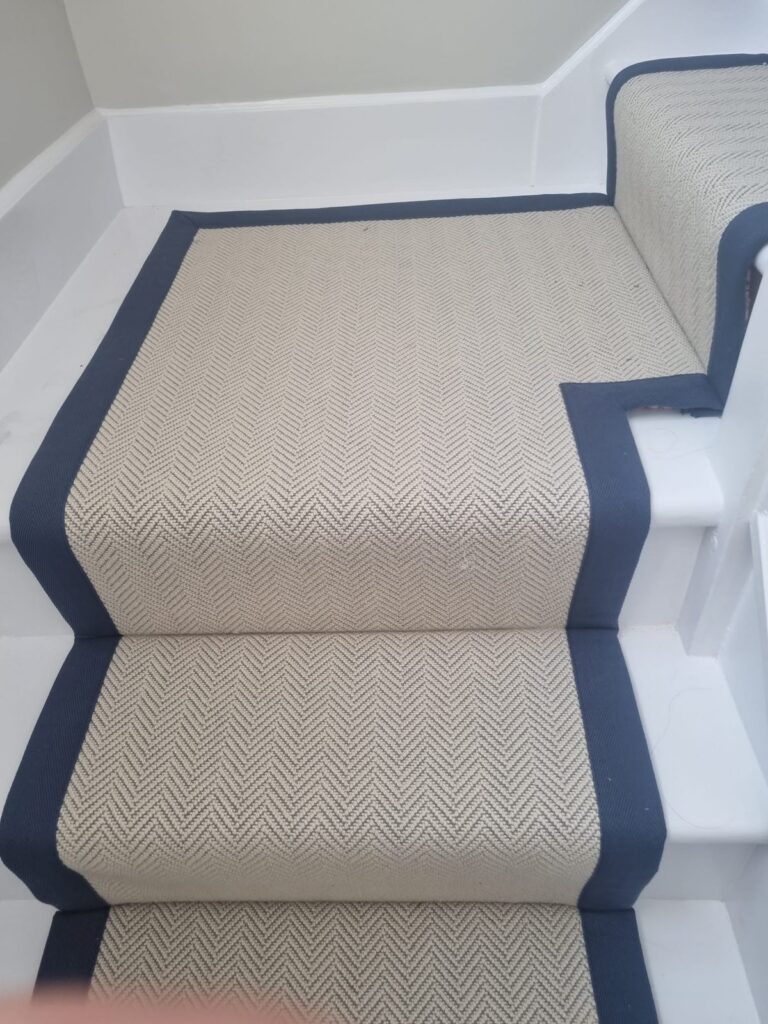
It is also the most exacting carpet job in the house. A runner has to sit perfectly central on every tread, keep an even margin of exposed timber on both sides, hold its pattern true from the bottom step to the landing, and turn a winder corner without the border breaking its line. There is nowhere to hide. That is why we fit runners with our own team rather than passing the work on.
Flatweave runners have no pile to crush, so they hold their appearance on a busy staircase far longer than a cut pile will. Herringbone, chevron and basketweave constructions bring texture without pattern repeat problems on the turns. They suit a family home where the stairs take constant traffic, and they sit well against painted or stained timber.
Wool runners feel warmer underfoot and quieten a hard staircase noticeably. An 80 per cent wool blend gives you resilience with the comfort, and there is a wide choice of plains, stripes and heathers. We stock a full range in the showroom, including our Victoria Carpets collections.
Sisal, seagrass and wool sisal blends give a stair runner real texture and a relaxed look. They need a little more thought on a staircase, since some naturals are firmer underfoot and less forgiving of spills, so we will talk you through which constructions work on stairs and which are better kept to a bedroom floor.
A striped runner needs the stripe to run true and square on every tread, which is a measuring and fitting question as much as a design one. On a staircase with winders, we will show you at survey stage how the pattern will behave on the turns before you commit.
The edge finish changes the character of a runner more than most people expect. There are three main options.
Tape binding. A woven cotton or linen tape sewn along both edges, in a plain or patterned weave. This is what gives the Barnet staircase above its navy outline. It is the strongest way to make a runner look deliberate rather than like a cut strip of carpet.
Whipping. A yarn stitched over the raw edge, either matching the runner or in a contrast colour. Softer and less pronounced than a tape, and a good choice when you want the texture of the carpet to lead.
Leather or faux leather trim. A firmer, more tailored edge that works well with natural fibre runners and darker timber.
Runners are fitted one of two ways, and the choice affects both the look and the price.
Gripper rods. The runner is held in place by gripper strip in the angle of every tread and riser, with underlay beneath. This is the standard method, it holds the runner tight to the shape of the step, and the fixings are invisible. It is what we used in Barnet.
Stair rods. Decorative metal rods sit in the angle of each step in brackets. Rods are largely ornamental on a modern fitting, since the runner is still held by grippers underneath, but they suit a traditional hallway and can be specified in brass, chrome, antique finishes and more.

Showroom visit or call. Come to the showroom on High Road in North Finchley to handle the flatweaves, wools and naturals in person, or ring us to talk through what you have in mind.
Home survey and measure. We measure the flight, count the treads and risers, check for winders, bullnose steps and landings, and confirm the runner width and the margin of timber you want left showing either side.
Quotation. A written quote covering the runner, the binding or whipping, underlay, grippers, fitting and the removal of any old carpet.
Binding and preparation. The runner is cut to length and bound to your chosen finish. Any preparation to the staircase itself is agreed beforehand.
Fitting day. Our fitters lay the grippers and underlay, set the runner central, and work up the flight. Most straight staircases are completed in a day.
Vacuum the runner regularly with the beater bar off on a flatweave, and deal with spills quickly rather than letting them dry in. Wool runners benefit from a professional clean every couple of years, and wool is the fibre most at risk if you have carpet moth in the house. If you have seen damage on a wool carpet or runner elsewhere in the property, our carpet moth treatment service deals with the problem properly before new carpet goes down.
We supply and fit stair runners across North London and Hertfordshire, working from our North Finchley showroom.
Bring a photo of your stairs to the showroom, or ring for a home survey. We will measure, advise on the runner width and border, and quote in writing.
Call 020 3115 1073 or 07714 101112, or visit the showroom at 870 High Road, North Finchley, London N12 9RH.
Most staircases look right with a margin of 75mm to 125mm of timber showing each side. Narrower margins make the flight feel wider, broader margins make more of the paintwork or timber. We mark it up at survey so you can see it on your own stairs before deciding.
Yes. Winders are the most demanding part of the job, because the runner has to be cut, folded and rebound so the border carries round the corner without breaking. The Barnet staircase above shows exactly that turn. It takes longer than a straight flight and we allow for it in the quote.
No. On a modern fitting the runner is held by gripper strip underneath, so rods are decorative rather than structural. Plenty of clients choose them for the traditional look, and we can supply them in a range of finishes.
Flatweave and wool both perform well. Flatweaves have no pile to flatten, so they keep their look on a heavily used flight, while wool gives more comfort and sound absorption. The right answer depends on how busy the staircase is, whether there are pets and children, and the look you want.
A straight flight is usually a day. Add time for winders, a half landing, a second flight or the removal of old carpet and grippers. We confirm the timing when we quote.
Yes, and it is one of the most popular combinations we do. The paintwork needs to be sound and fully cured first. If you are painting the staircase yourself, finish the painting well before the fitting date.
Yes. We supply the carpet, the binding or whipping, underlay, grippers and rods, and we fit it. If you would rather see the ranges first, everything is on display at the showroom in North Finchley.